



Let’s be real for a second. If you’re reading this, you probably have a server somewhere in the basement that everyone is afraid to touch. You know the one—it runs a critical piece of your business, the code was written in 1998 by a guy named Dave who retired three years ago, and every time you need to update a feature, the whole thing threatens to implode.
That is the reality of legacy software systems.
They are the silent killers of innovation. While your competitors are deploying updates weekly, you’re stuck in “maintenance mode,” burning cash just to keep the lights on. But ripping everything out and starting from scratch usually isn’t an option. It’s too expensive and too risky.
So, what’s the middle ground? How do you move from a clunky monolith to a sleek, modern machine without pausing your business? The answer lies in a strategic triad: Cloud, APIs, and Microservices.
💡 Key Takeaways
- Status Quo is Expensive: Maintaining legacy systems often costs more than modernizing them due to technical debt and security risks.
- The Big Three: Cloud infrastructure, API layers, and Microservices are your primary tools for modernization.
- Don’t Rewrite, Refactor: You don’t always need a full rewrite. Strategic wrapping and incremental migration reduce risk.
- Talent Gap: Finding developers for COBOL or old Java versions is getting harder; modernization opens you up to a wider talent pool.
The Hidden Cost of Doing Nothing
You might think, “If it ain’t broke, don’t fix it.” But legacy systems are broke; you just haven’t seen the bill yet.
Every day you delay modernization, you accrue technical debt. This isn’t just a buzzword. It’s the extra time your developers spend working around old code instead of building new features. It’s the security patch that can’t be applied because your OS is no longer supported. It’s the inability to integrate with Salesforce or Stripe because your database speaks a language from the dot-com bubble.
Keeping legacy software systems on life support is like fixing a classic car with duct tape. Eventually, the engine blows.
The Modernization Triad: Cloud, APIs, & Microservices
Okay, we know the problem. Let’s talk about the solution. You don’t have to eat the elephant in one bite. You can tackle migration using these three pillars.
1. The Cloud: More Than Just “Someone Else’s Computer”
Migrating to the cloud isn’t just about dumping your on-premise servers into AWS or Azure (that’s called “Lift and Shift,” and it’s arguably the laziest way to migrate).
True cloud modernization means Refactoring. It means optimizing your application to use cloud-native features like auto-scaling and managed databases.
- Scalability: Black Friday traffic spike? The cloud handles it automatically. Your basement server would just catch fire.
- Security: Cloud providers spend billions on security. Do you?
- Cost Efficiency: Stop paying for idle hardware. Pay for what you use.
2. APIs: The Bridge Between Old and New
This is my favorite strategy for risk-averse businesses. If you can’t replace your legacy core immediately, wrap it in APIs.
Think of APIs (Application Programming Interfaces) as a translator. You keep your old, reliable mainframe running in the background, but you build a modern API layer on top of it. Your new mobile app or web portal talks to the API, and the API talks to the legacy system.
This allows you to innovate on the frontend today while slowly updating the backend tomorrow. It buys you time and immediate functionality.
3. Microservices: Breaking the Monolith
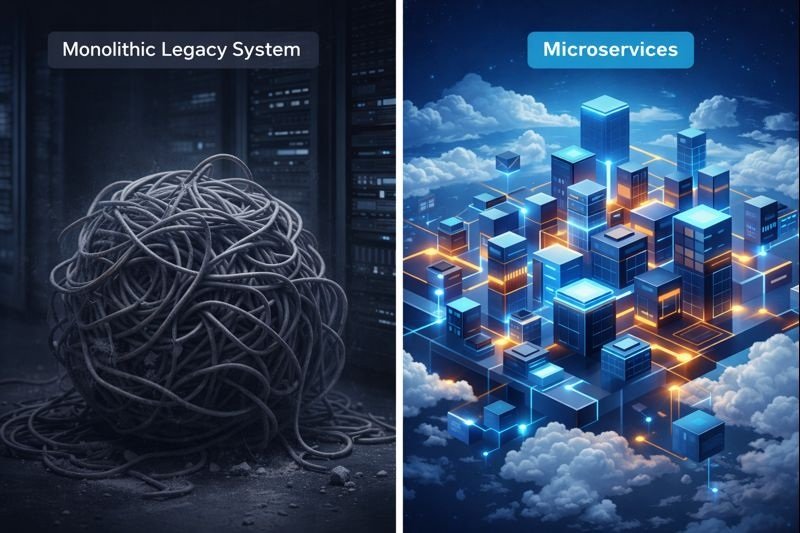
Most legacy software systems are “monolithic.” This means the user interface, the business logic, and the data access layer are all mashed into one giant block of code. If you want to change the “Checkout” button, you might accidentally break the “Inventory” system.
Microservices break that block into tiny, independent pieces. The “User Profile” is a service. “Billing” is a service. “Notification” is a service.
- Independence: One team can update the Billing service without talking to the User Profile team.
- Resilience: If the Notification service crashes, the rest of the app keeps running. In a monolith, one error brings the whole house down.
Comparison: The Old Way vs. The New Way
Here is a quick breakdown of why the shift makes sense financially and operationally.
| Feature | Monolithic Legacy System | Modern Cloud & Microservices |
|---|---|---|
| Updates | Deployments happen once a year (scary). | Deployments happen daily (routine). |
| Scaling | Buy more physical servers (slow/expensive). | Click a button to auto-scale (instant). |
| Failure | One bug crashes the whole system. | Failure is isolated to one specific function. |
| Technology | Stuck with outdated languages (COBOL, old Java). | Use the best language for the specific job. |
How to execute a “Strangler Fig” Migration
You don’t need a “Big Bang” rewrite. In fact, I advise against it. The most successful migrations I’ve overseen use the Strangler Fig Pattern.
Imagine a vine growing around a tree. Eventually, the vine becomes the structure, and the tree rots away.
- Identify one distinct function in your legacy system (e.g., “Invoicing”).
- Build a new Microservice for Invoicing in the cloud.
- Redirect traffic: When a user clicks “View Invoice,” the API sends them to the new service, not the old one.
- Repeat: Do this for User Management, then Inventory, then Reporting.
- Retire: Once all functionality is moved, turn off the legacy system.
This approach minimizes risk. If the new Invoicing service fails, you just route traffic back to the old system while you fix it. Zero downtime, zero panic.
Frequently Asked Questions
1. Is it cheaper to maintain legacy software systems or rewrite them? In the short term, maintenance looks cheaper on a spreadsheet. But when you factor in downtime, security breaches, and the inability to launch new products, legacy systems are vastly more expensive in the long run.
2. How long does a migration take? It varies. A “Lift and Shift” to the cloud can take weeks. A full refactor to microservices usually takes 6 to 18 months depending on complexity. The beauty of the Strangler Fig pattern is that you get value during the process, not just at the end.
3. What are the biggest risks in migration? Data loss and business interruption. This is why we never recommend a “Big Bang” switch-over. Always migrate data incrementally and run systems in parallel (shadow mode) to verify accuracy before flipping the switch.
The Bottom Line
Modernizing your legacy software systems isn’t just an IT ticket; it’s a business imperative. The market moves too fast for you to be shackled to code written twenty years ago.
By leveraging the Cloud for scale, APIs for connectivity, and Microservices for agility, you turn your tech stack from a liability into your biggest asset.