



If you or a loved one has ever faced a cancer diagnosis, you know the anxiety that surrounds “the biopsy.”
For decades, the gold standard for diagnosing cancer has been the tissue biopsy. It involves needles, scalpels, surgical scheduling, and often, a painful recovery. It’s invasive, and frankly, it’s something no patient looks forward to.
But medicine is changing. There is a quieter revolution happening in oncology that promises to make cancer detection as simple as a standard blood draw.
It’s called a liquid biopsy test, and it is changing how doctors find, treat, and monitor cancer.
If you’ve heard the term floating around doctor’s offices or medical news and wondered what it actually means for patients, this guide is for you. We’re skipping the medical jargon to explain exactly what this test is, how it works, and why it matters.
What Exactly Is a Liquid Biopsy?
In simple terms, a liquid biopsy is a test that looks for signs of cancer in your blood (or occasionally other fluids like urine) rather than taking a piece of tissue from a tumor.
Here is the science, simplified:
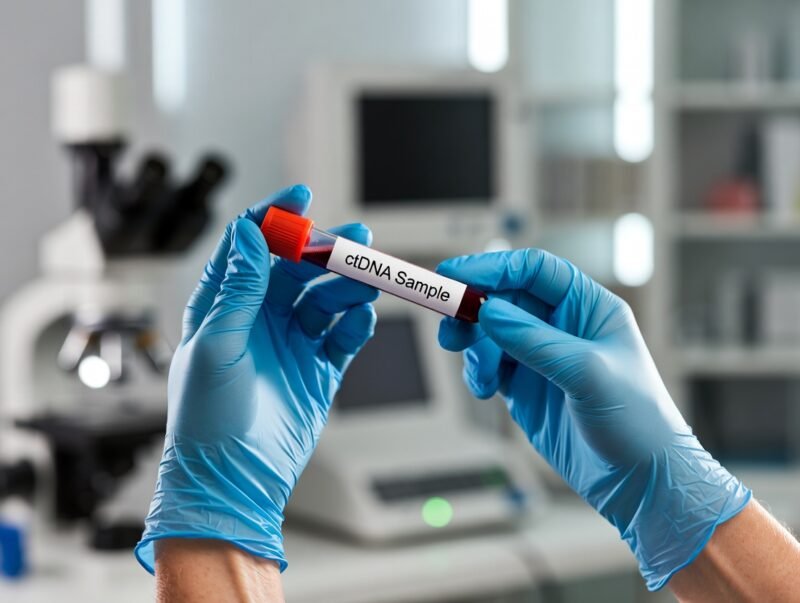
Tumors are not self-contained. As cancer cells grow and die, they shed tiny fragments of their DNA into your bloodstream. These fragments are called circulating tumor DNA (ctDNA).
Think of it like a stream flowing past a construction site. Even if you can’t see the construction site itself, you might find debris—sawdust or wood chips—floating downstream.
A liquid biopsy test analyzes your blood to find that “debris.” By sequencing this DNA, doctors can identify specific genetic mutations associated with cancer without ever having to cut into the body.
Liquid Biopsy vs. Tissue Biopsy: What’s the Difference?
The tissue biopsy isn’t going away completely—it is still crucial for initial diagnoses. However, the liquid approach solves some major problems that traditional biopsies cannot.
Here is how they compare:
1. Invasiveness
Tissue Biopsy: Requires a needle puncture or surgery. Depending on where the tumor is (like the lung or liver), this can be risky and painful. Liquid Biopsy: Requires a standard blood draw from your arm.
2. Speed
Tissue Biopsy: It can take weeks to schedule the procedure, recover, and wait for pathology reports. Liquid Biopsy: Results are often available in 7 to 10 days. When fighting cancer, speed is everything.
3. The “Whole Picture”
A tissue biopsy only tests a tiny sample of a tumor. If the tumor has different mutations in different parts (which is common), a needle might miss key information.
Because blood circulates through the entire body, a liquid biopsy test can sometimes provide a more comprehensive snapshot of the cancer’s genetic makeup, capturing mutations that a single tissue sample might miss.
When Is a Liquid Biopsy Used?
Right now, this isn’t a replacement for mammograms or colonoscopies for the general public, though research is moving in that direction. Currently, doctors use liquid biopsies in three main scenarios:
Matching Patients to Targeted Therapies
If a patient has advanced lung cancer, for example, doctors need to know if the tumor has a specific mutation (like EGFR or ALK) to prescribe a targeted pill rather than generic chemotherapy. A liquid biopsy can find these mutations quickly.
Monitoring Treatment Success
How do you know if a treatment is working? Historically, you had to wait months for a CT scan to show if a tumor shrank.
With liquid biopsies, doctors can track the levels of tumor DNA in the blood. If the levels drop, the treatment is working. If they rise, the cancer might be resisting the drug, allowing doctors to pivot strategies sooner.
Detecting Recurrence
After surgery to remove a tumor, the biggest fear is that it will come back. Liquid biopsies can sometimes detect microscopic traces of cancer returning months before it would show up on a visible scan.
The Limitations: It’s Not Magic (Yet)
While the technology is exciting, we need to be realistic.
False Negatives are possible. Sometimes, a tumor just doesn’t shed enough DNA into the blood to be detected. A negative liquid biopsy result doesn’t always mean “no cancer.” In these cases, a doctor will usually default back to a tissue biopsy to be sure.
It’s not for every cancer. While it is widely used for non-small cell lung cancer, breast cancer, prostate cancer, and colorectal cancer, it is not yet standard for every type of malignancy.
Cost and Insurance. Because this is newer technology involving advanced genomic sequencing, it can be expensive. In the U.S., Medicare and many private insurers cover it for specific indications (like non-small cell lung cancer), but coverage varies. Always check with your provider.
Is This the Future of Screening?
This is the big question everyone asks: Can I get a blood test to tell me if I have cancer before I get sick?
We are getting close. There are now “multi-cancer early detection” (MCED) tests entering the market that screen for dozens of cancers at once using liquid biopsy technology.
However, these are largely still in clinical trials or available mostly out-of-pocket. The medical community is cautious—they want to ensure these tests don’t lead to false alarms that cause unnecessary anxiety and procedures.
Conclusion
The liquid biopsy test represents a shift from reactive medicine to precision medicine. It treats the patient, not just the scan.
For many, it means fewer painful procedures. For others, it means getting on the right life-saving medication weeks sooner than they otherwise would have.
If you are navigating a cancer diagnosis, ask your oncologist if a liquid biopsy is appropriate for your specific situation. It might just provide the answers you need, without the invasive procedure you don’t.
Frequently Asked Questions
Is a liquid biopsy painful? No more than a regular blood test. A phlebotomist will draw a few tubes of blood from your arm. There is no recovery time, and you can drive yourself home immediately afterward.
How much does a liquid biopsy test cost? The cost can range from $2,000 to over $4,000 if paying out of pocket. However, if the test is medically necessary (especially for advanced cancer treatment selection), most major insurance plans and Medicare often cover a significant portion.
Can a liquid biopsy replace a tissue biopsy completely? Not yet. Tissue biopsies are still the most accurate way to confirm an initial cancer diagnosis and determine the cell type. Liquid biopsies are currently best used as a complement to tissue biopsies, or when a tissue biopsy isn’t safe to perform.
How long does it take to get results? Turnaround times have improved drastically. Most patients receive their results within 7 to 10 business days, which is often faster than the scheduling and processing required for surgical biopsies.