


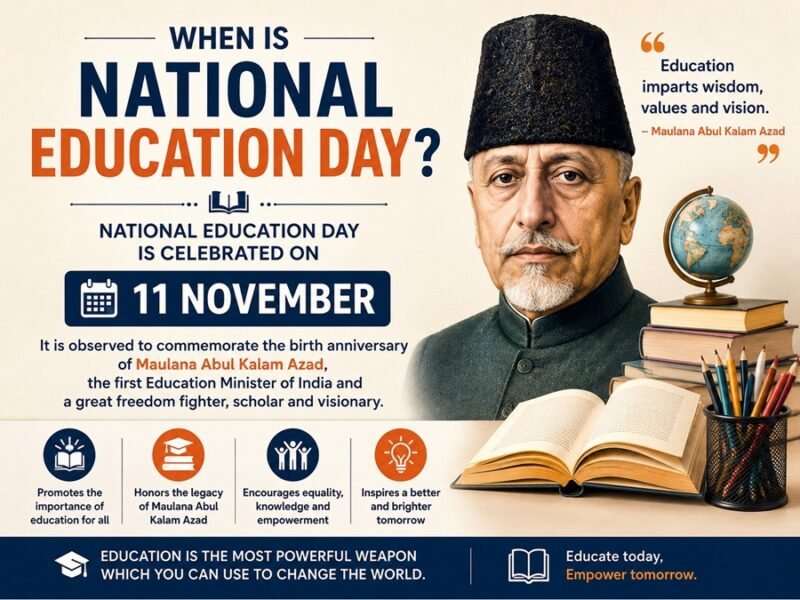

National Education Day is observed every year on November 11 in India. The date marks the birth anniversary of Maulana Abul Kalam Azad, India’s first Minister of Education. Here’s everything you need to know about the day — its history, significance, and how it’s observed across the country.
When Is National Education Day 2026?
National Education Day 2026 falls on Wednesday, November 11, 2026.
It is observed on the same date every year, since it’s tied to a fixed historical event — Maulana Azad’s birth anniversary — rather than a variable calendar date.
Who Was Maulana Abul Kalam Azad?
Maulana Abul Kalam Azad was a freedom fighter, scholar, and statesman who became independent India’s first Minister of Education, serving from August 15, 1947, to February 2, 1958.
Key facts about his life and legacy:
- Born on November 11, 1888, in Mecca, Saudi Arabia, into a family of Muslim scholars
- Educated at home in Arabic, Persian, Urdu, and English before developing expertise in Islamic theology, philosophy, and literature
- Played a major role in India’s independence movement and served as the youngest president of the Indian National Congress
- Founded the Urdu weekly Al-Hilal in 1912, a platform for anti-colonial ideas
- Passed away in Delhi on February 22, 1958
As Education Minister, Azad laid the foundation for much of India’s modern education system, including:
- The University Grants Commission (UGC)
- The All India Council for Technical Education (AICTE)
- Expansion of technical education, including the early groundwork for the IITs
- Cultural and literary institutions like the Sahitya Akademi, Lalit Kala Akademi, and Sangeet Natak Akademi
Several institutions are named in his honor today, including Maulana Azad Medical College (Delhi), Maulana Azad National Urdu University (Hyderabad), and the Maulana Abul Kalam Azad University of Technology (Kolkata).
Why Is November 11 Chosen for This Observance?
The date isn’t symbolic or arbitrary — it’s simply Maulana Azad’s actual birth date. By tying National Education Day to his birthday, the government intended to permanently link his legacy with India’s ongoing commitment to education.
History of National Education Day
- September 11, 2008: The Ministry of Human Resource Development (now the Ministry of Education) officially announced that November 11 would be observed as National Education Day, honoring Maulana Azad’s contributions
- November 11, 2008: The first official observance took place at Vigyan Bhawan, New Delhi, with then-President Pratibha Patil presiding over the event
- Since 2008, the day has been observed annually across schools, colleges, and educational institutions nationwide
Important note: National Education Day is an official observance, not a gazetted public holiday. Schools, colleges, and offices typically remain open, and the day is marked through events, seminars, and educational activities rather than a day off.
How Is National Education Day Observed?
Across India, schools, colleges, and educational institutions mark the day with:
- Seminars and discussions on the state of education in India and ways to improve it
- Essay and debate competitions for students on themes related to literacy and learning
- Award ceremonies recognizing outstanding teachers, students, or institutions
- Awareness campaigns on the importance of education and accessible learning
- Cultural programs celebrating Maulana Azad’s life and contributions
Educational institutions, NGOs, and EdTech platforms also use the day to launch or promote:
- Scholarship programs for underprivileged students
- Free access to courses or learning resources
- Donation drives supporting school supplies, tuition, or literacy programs
Why National Education Day Still Matters
Beyond honoring Maulana Azad’s legacy, the day serves as an annual checkpoint for India to reflect on its education system:
- Literacy remains an ongoing challenge in parts of India, particularly in rural and underserved regions
- It’s an opportunity to spotlight inclusive and accessible education, a value Azad strongly advocated for
- It encourages corporate and community involvement — from CSR-driven scholarship programs to grassroots literacy drives by NGOs working in child education
FAQs: National Education Day
Q1. When is National Education Day celebrated in India?
National Education Day is celebrated every year on November 11, marking the birth anniversary of Maulana Abul Kalam Azad.
Q2. Is National Education Day a public holiday?
No. It is an official observance day, not a gazetted holiday. Schools and offices generally remain open, and the day is marked through events and educational activities.
Q3. Why was November 11 chosen for National Education Day?
November 11 is Maulana Abul Kalam Azad’s actual date of birth. The Indian government chose this date to permanently honor his legacy as the country’s first Education Minister.
Q4. Who was Maulana Abul Kalam Azad?
He was a freedom fighter, scholar, and India’s first Minister of Education after independence, serving from 1947 to 1958. He is credited with laying the foundation for institutions like the UGC and AICTE.
Q5. When was National Education Day first observed?
The Indian government announced the observance in September 2008, and the first National Education Day was celebrated on November 11, 2008, at Vigyan Bhawan, New Delhi.
Q6. How can schools or organizations mark National Education Day?
Common ways include hosting seminars, essay or debate competitions, honoring teachers and students, launching scholarship or donation drives, and running awareness campaigns on accessible education.
Final Thoughts
National Education Day is a reminder of how far India’s education system has come — and how far it still needs to go. Honoring Maulana Abul Kalam Azad’s legacy each November 11 isn’t just about looking back; it’s a call to keep pushing for inclusive, quality education for every child across the country.