


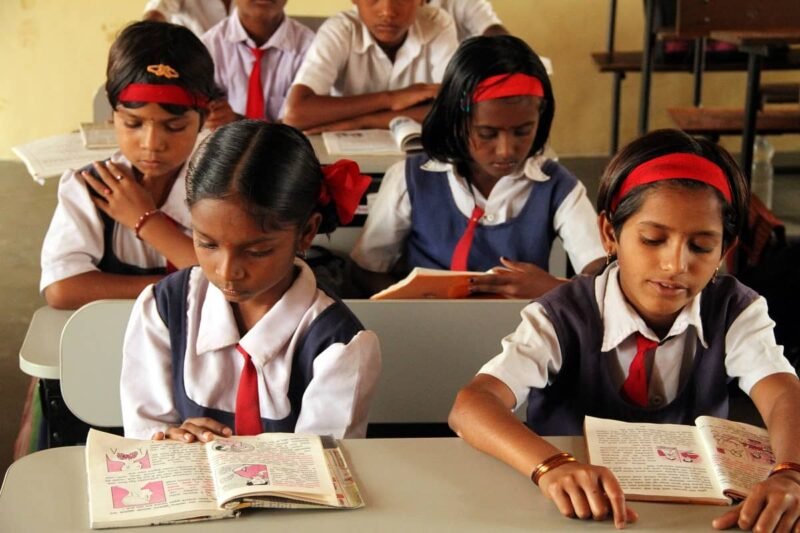

When you educate a boy, you educate an individual. When you educate a girl, you educate an entire generation.
While India has made commendable strides in primary school enrollment, retaining girls through secondary and higher secondary education remains a monumental national challenge. According to recent demographic trends, dropouts among adolescent girls surge drastically between the ages of 11 and 16. The reasons are rarely academic; they are deeply rooted in social, financial, and infrastructural barriers.
As a premier national organization, Child Rights and You (CRY) has spent decades working on the ground to dismantle these barriers. Here is an inside look at 5 highly effective, field-tested strategies on how to improve girl child education and keep India’s daughters in the classroom.
1. Building Functional Infrastructure (The Sanitation Factor)
It is an uncomfortable truth, but a lack of basic school infrastructure is a primary driver behind adolescent girls dropping out. When a girl hits puberty, the absence of a clean, functional, and separate girls’ toilet makes managing her periods at school nearly impossible. Rather than facing monthly loss of dignity, many choose to quit school entirely.
CRY addresses this by working directly with local school management committees and state authorities to optimize school infrastructure.
-
The Strategy: Installing functional, private sanitation blocks with running water.
-
The Impact: Providing menstrual hygiene management (MHM) kits and conducting awareness workshops to eliminate the taboo surrounding periods, ensuring girls don’t miss up to five days of school every month.
2. Setting Up Doorstep Tracking and Early Warning Systems
To prevent a girl from dropping out, you have to catch the warning signs before she stops showing up. In rural and marginalized urban blocks, a girl missing school for three consecutive days often indicates she is being kept home to care for younger siblings, manage domestic chores, or prepare for an early marriage.
CRY deploys localized, community-led surveillance networks known as Bal Sanrakshan Samitis (Child Protection Committees).
[Girl Student Misses School for 3 Days]
                   │
                   ▼
[Local Committee Automatically Flags Absence]
                   │
                   ▼
[Immediate Doorstep Visit & Parental Counseling]
                   │
                   ▼
[Root Problem Resolved ➔ Girl Mainstreamed Back to Class]
These committees consist of village elders, Anganwadi workers, and teachers who conduct immediate doorstep counseling to resolve family crises before the girl falls out of the formal education system.
3. Creating Safe Transports to Eliminate “Distance Fear”
In many rural regions, primary schools exist within the village, but secondary and higher secondary schools are located kilometers away in neighboring towns. For parents, walking along deserted roads poses a severe safety risk to their daughters, leading them to withdraw girls from school after Class 5 or 8.
CRY tackles this geographical barrier through collective community and state advocacy:
-
Activating Government Schemes: Helping eligible girls access state-sponsored bicycle distribution programs (like the Saraswati Cycle Yojana or similar regional initiatives).
-
Community Caravans: Organizing collective, supervised walking groups or pooling local transport resource routes to ensure girls travel to distant school blocks in safe, secure groups.
4. Financial Shielding via Girl-Centric Scholarships
In economically weaker households with limited resources, parents often prioritize a son’s private schooling over a daughter’s public education, viewing the girl’s education as a low-return investment due to deep-rooted patriarchal norms.
To shift this mindset, CRY actively bridges the gap between vulnerable families and state welfare systems. They map out and enroll eligible adolescent girls into targeted government conditional cash transfer schemes (such as Sukanya Samriddhi Yojana or state-specific girl-child scholarships). When parents see that keeping their daughter unmarried and enrolled in school brings direct financial support and long-term security, the economic pressure to pull her out vanishes.
5. Activating Adolescent Girls’ Collectives (Kishori Mandals)
True empowerment cannot just be managed for girls; it must be driven by girls. CRY establishes localized youth groups called Kishori Mandals (Ad adolescent girls’ collectives).
These groups serve as a safe space where young girls learn about their legal rights, reproductive health, and the dangers of child marriage. Girls gain the confidence and public speaking skills needed to negotiate with their parents, voice their career aspirations, and even collectively intervene to stop child marriages within their peer circles.
The Measurable Difference
CRY’s comprehensive approach to how to improve girl child education delivers undeniable data-backed results across its intervention zones.
| Metric in CRY Project Areas | CRY Progress Status | National Baseline Context |
| Adolescent Girl Retention (Ages 11-18) | 88% Retention Rate | Systematically higher than regional rural averages |
| Protection from Early Marriage | 99% Protection Rate | Safely shields girls from underage marital traps |
| School Infrastructure Upgrades | Hundreds of schools optimized | Direct provisioning of functional girls’ toilets and running water |
A Real-Life Victory: In a remote village block in Asia’s largest slums and rural districts, CRY-supported collectives successfully stopped over dozens of underage marriages in the last year alone, turning former potential child brides into first-generation college aspirants.
Be a Part of Her Success Story
Improving girl child education across a nation as vast as India requires relentless tracking, systemic policy pressure, and continuous resources. You can directly accelerate this movement:
-
Sponsor a Girl Child’s Education: Your direct contributions to CRY help provide learning kits, fund academic support centers, and upgrade rural school sanitation facilities.
-
Amplify the Message: Champion girl-child advocacy within your professional and social networks to dismantle structural biases.
When you invest in a girl’s education, you aren’t just keeping a child in a classroom—you are empowering a future leader, professional, and independent citizen who will lift her entire community out of poverty.